Modern web based user interface
Highly scalable data store
Built on open, standard technologies
Standard full featured, dynamic scripting language
Robust and easy integration with management tools
Integrated full text search engine
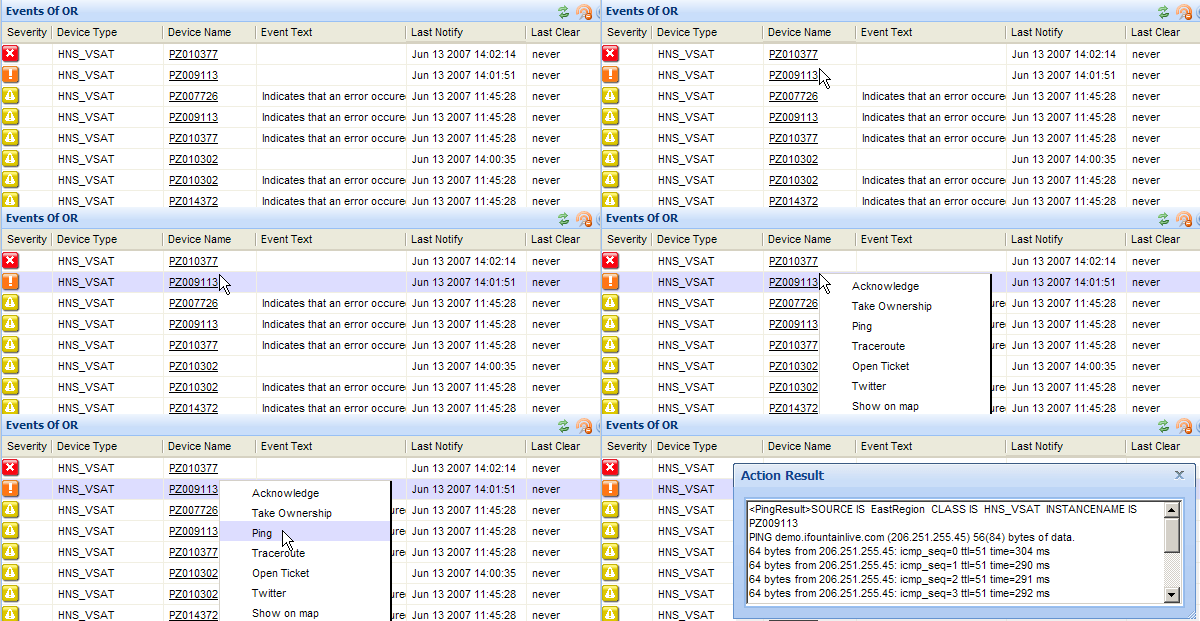
RapidOSS not only presents information to users, but also enables users to take appropriate actions directly from the browser, in context of the presented information.
Learn MoreHigh performance web application, no java applets or ActiveX
Learn MoreOne system to serve multiple users/customers using data segmentation. Users can be restricted to have access only to subset of the data
Learn MoreOne repository for active and inactive events. Don't have remove inactive events.
Learn MoreRapidOSS Features: Active RapidOSS not only presents information to users, but also enables users to take appropriate actions right from the browser, in context of the presented information. RapidOSS enables dashboards to become more than glorified reports where users are presented information yet cannot initiate any actions using that information. Using RapidOSS actions, appropriate actions can be implemented as part of the dashboard, enabling users to act without requiring the user to go to another system, etc. Users can execute actions like the following using the drop down menu options, clicking hyperlinks, etc. all through a consistent user interface without having to reenter the same information. Manage events (acknowledge, take ownership, etc.) add comments run additional tests launch other applications in context forward information to others execute shell scripts
RapidOSS Features: Event Management User Interface RapidOSS event management user interface is an Ajax application (javascript/html). It does not use java applets or ActiveX in the browser that introduces high administrative overhead and integration problems. User interface is optimized for use in IT operations and introduces number of innovative features in addition to the traditional event management user interface patterns. Full text search enables users to find the relavant events quickly without having to know how to write SQL queries, etc. Event search UI enable users to fine tune their queries by clicking on the properties of the events in the search results. Users can define different set of properties to be displayed for different type of events by associating the views with queries they've created. Users can execute in context actions directly from events Event management user interfaces are optimized to handle large number (thousands) of events.
Many dashboard/portal solutions are complicated projects and have steep learning curves. Keeping the solution simple has been a key design principle for RapidOSS from the beginning. As a result, RapidOSS is easy to implement, easy to extend, and easy to maintain.
Fast deployment. RapidOSS includes all the necessary ingredients to get the solution up and running. No external dependencies.
Platform independent. Server side application runs in the Java Virtual Machine, therefore can run on any platform with that has supported JVM.
AJAX client. RapidOSS has an Ajax user interface and does not use java on the client, and plays nice with other applications. No more JVM conflicts on the browser.
Standard technologies. RapidOSS leverages well known technologies and do not rely on proprietary languages, etc. therefore does not mandate product specific training.
Simple user interface. Only the necessary functionality that is aligned with the business processes can be exposed, enabling users to start using the solution quickly, eliminating potential training costs.
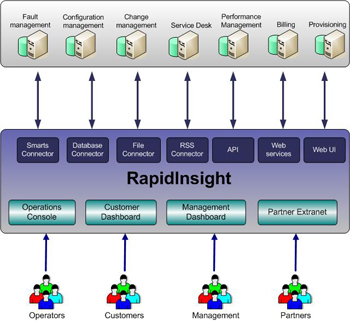
RapidOSS Features: Unified RapidOSS enables users to access to information from disparate systems (monitoring tools, help desk systems, change control systems, etc.) from a single, consistent user interface, that is aligned with business process and exposes only the necessary functionality. Operational support systems consist of number of different tools. As a response to demands by the business users, most of the tools do provide a web based interface to users. Early dashboard and portal implementations have focused on providing access to operational support systems through the interfaces provided by each of the tools stiched together through a single sign-on mechanism. Business users demand to access the information that is aligned with their processes and not organized based on the underlying tools. RapidOSS uses the presentation layer integration approach and does not require lengthy and often problematic back end integration among the involved tools.
RapidOSS is an "open project". Not only RapidOSS source code is available as open source, it also leverages existing open source libraries and tools whenever possible, rather than duplicating their functionality. RapidOSS is designed from the ground up to facilitate easy integration with other tools. The server exposes all its functionality through a simple to use web API. RapidOSS components including the Ajax client makes use of this API. RapidOSS also provides a set of connectors to integrate with other systems. Connectors are ready-to-use components that take care of the most of the tedious, high risk activities, allowing only the business logic to be specified, using a standard scripting language, Groovy. No proprietary languages here. RapidOSS has a growing list of connectors that already include file, socket, RSS, database (jdbc), EMC/Smarts, IBM/Netcool, etc. On the client side, an added benefit of using Ajax is to be able to integrate with other web applications easily, using familiar web technologies, rather than proprietary tools common in many solutions. 3rd party client libraries, web pages, etc. can easily be integrated into the user interface. Mashups are possible as the client components provide capability to exchange data.
RapidOSS Features: Tailored RapidOSS provides tailored views for users with different roles. Executives, customers, operators, engineers, line of business managers, etc. all have different needs and interests.. RapidOSS dashboards can bring the right level of information to users depending on their needs, exposing only as much functionality as needed, offering simplicity to casual users and power to advanced users.
RapidOSS Features: LDAP and Data Segmentation RapidOSS supports LDAP and Active Directory for user authentication. RapidOSS also provides data segmenting capabilities to ensure users can only have access to data they are authorized to. Inclusive filters can be assigned to groups to specify which objects the members of the group are authorized to access. This functionality is particularly useful in shared services environments where IT management infrastructure is shared. Data segmentation provides significant cost savings by allowing IT management information to be served to internal and external customers without multiplying the number of management systems,
RapidOSS Features: Full Text Search Google has made search the most common paradigm to find information. RapidOSS includes a powerful search engine (Compass) to enable users to find IT management data using google like queries. Users can find the information they seek without having to know SQL , other complex query languages, where data resides or how it's structured.
Default event management actions such as acknowledge, assign ownership, escalate, etc. are implemented as "operations" of the RsEvent class. RapidInsigth provides a default event lifecycle management capabilities based on leading practices, however it does not dictate "one true way" on IT organizations. Event management actions are completely customizable in the field, hence can be aligned with the operational processes easily. This flexibility also enables RapidOSS to work in conjunction with other event management systems such as Tivoli Netcool and EMC/Smarts.
RapidOSS Features: Event History RapidOSS uses the outstanding Compass framework to store all its data as lucene indexes. Inactive events are stored as instances of RsRiHistoricalEvents class and accessible through the UI and the scripts like any other object. Lucene index files have minimal disk space requirements making it possible to keep historical events as part of repository. Event management systems typically require additional purchase of modules and relational databases which increases the complexity and the administrative overhead of the solution.
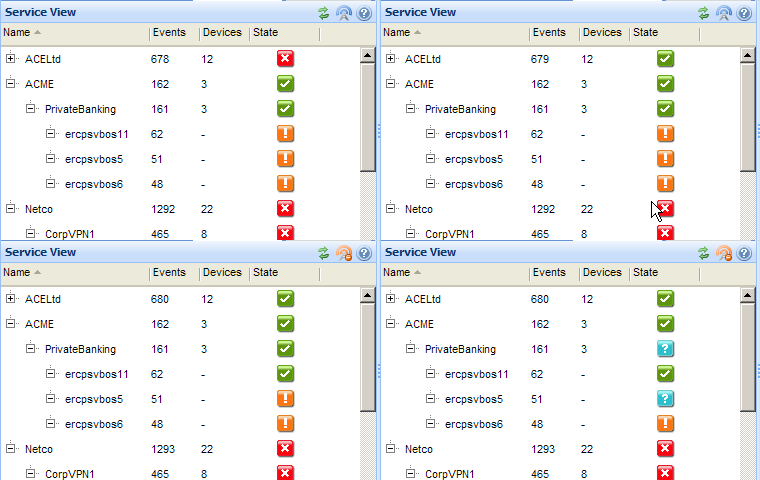
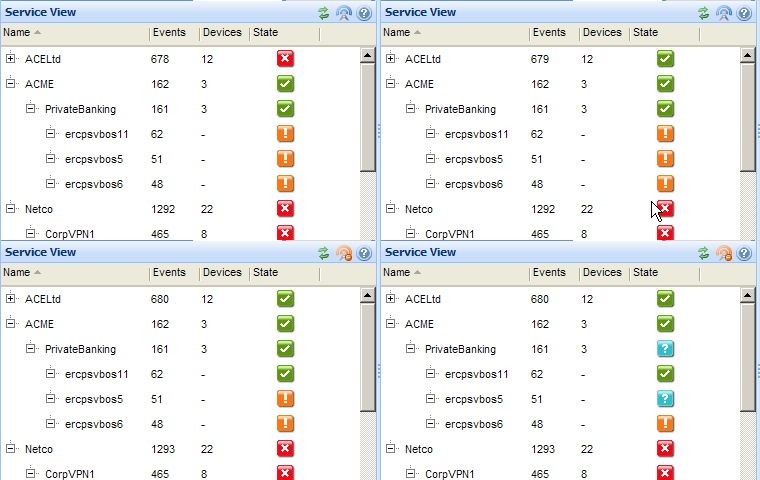
RapidOSS Features: Dynamic Many web based user interfaces provided by management tools still only present data in a static manner, where the information presented is not updated in real time. In order to be effective tools, dashboards need to present up to date information. RapidOSS UI components (grid, tree, charts, etc.) are inherently dynamic and the data presented by the components is seamlessly updated in near real time. Ajax techniques are used to update the user interface without page reloads as the data changes in the back end, all transparent to the users.
ApiGap is privately held software company incorporated in US. Our mission is to build a software company that embraces "open development philosophy" and provides innovative solutions to customer problems in collaboration with customers.
Phone : +1 (209) 266-1311
Email: info@apigap.com
ApiGap, Inc
2233 Watt Ave 282
PMB 36258
Sacramento, CA 95825